The news has begun to activate a part of me that was bullied as a young person, who experienced disadvantage just because I was short, and the part of me that found out on going to college that my rural education didn’t match up to the city kids. Memories become rage in my body/mind, a lava dome of upset pushing up against the crust of my conventional self, disturbing a hard-won sense of self-worth and maturity.

How long before this festering boil erupts in me and others? History does not comfort me, considering the implosion of other tyrannical systems. The fumes are filling the room of my awareness. What spark will ignite them, pushing my belief in human kindness into a well of grief and horror?

I don’t want the result to be numbness, or war in me or others. I experience an urge act, to move, to resist paralysis and denial. The kind of acts I trust is reaching out to others, to let you know you are not alone, so, I wrote a poem. Words help me titrate my feelings. I don’t want to take a political bypass, as Charles Eisenstein calls it, by grabbing a balloon of hope and floating off. But the Minnesotans are showing us that when people reach out and touch each other, and work from heart, that contagion can find a flow instead of a wall of flames. If this crisis brings us back into relationships, back into feeling the Earth, back into resisting othering as a way to feel better, then the crises have some value. I do know that the new springs from the composting of the old.  But the breaking down grabs at my heart.

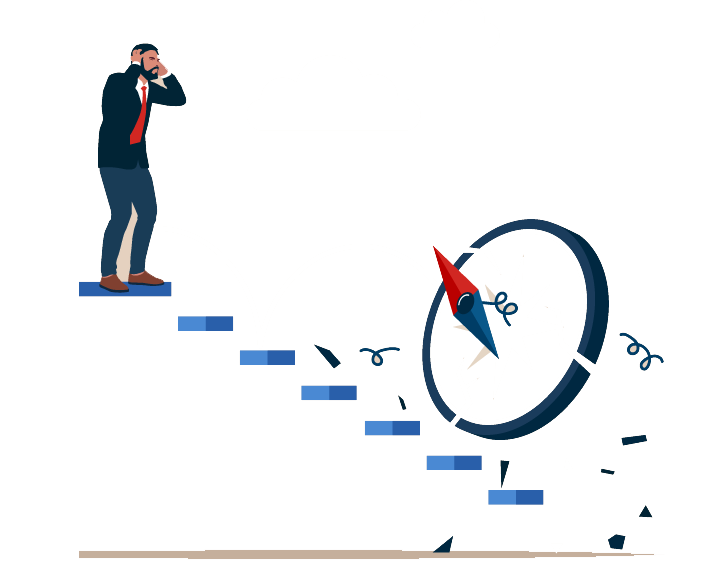
A BROKEN COMPASS

Our compass has lost its bearing,brokenonstairs

stopped feeling the living Earth’s magnetism

started spinning and spinning and spinning.


Did it lose its orientation

in the extreme heat of threats

or intentional damage at the pivot point,

bent by lies and murders conducted

right on camera

or was its needle flipped in the

presence of coils of rhetoric wound tightly in direct opposition

to guidance from the Earth?


This damage may be generations

in the making—seeing humans as objects

disconnected from other life,

disconnected from the long arms

of planetary influence, forgetting how

whales, geese and butterflies navigate

over thousands of miles.


Without a compass

we navigate by buoys instead,

listening for the loud horns along the prescribed

channels of thinking set by others.

avoiding known rocks.

lost in the open seas of change.


Is there a physics of morality?

Did we forget

that both inner and outer compasses

work by orientating

to larger fields of coherence

to resonance and compassion

to the living planet as a whole?


We need to move to something new.

It will take a compass that works.

It will take a multitude that is willing.

It will take embracing compost that stinks

until the new roses bloom.


By David Sibbet[/vc_column_text][/vc_column]

[/vc_row]


I just finished watching the Thinking Game, a 2024 Tribeca Festival selection about Demis Hassabis, CEO of Deep Mind and Nobel winner for his work on AI and folded proteins. The acceleration in AGI hopefulness was in its pitch of acceleration at that time this documentary was produced, in no small part to Deep Mind having mastered video gaming, go, and then folded proteins. Google’s early support was important or course. And now the game is on in ways even Hassabis might not have anticipated.

The Thinking Game | Full documentary | Tribeca Film Festival ...

As recent experiences with hallucinations, scamming, the environmental and economic costs of data centers, and the thought of cyber war mount people are beginning to seriously question the bubble. But AI is here. I think Hassabis is right saying that AI is like the development of electricity itself or possibly fire. The world is not turning back.

AI has been on my mind as I enter a period of contemplation about what I will do now that I’m retired from active graphic facilitation. My life partner Gisela Wendling is CEO of The Grove now and we are heading into leadership development, coaching and transformational change work. Of course, we are using the many tools I and The Grove team have developed over the years. But the world of process consulting has already changed. Organizations are not supporting the face-to-face processes upon which we developed our business. Hybrid work grows steadily, and now AI is catalyzing questions across the boards about how work is going to get done now that knowledge workers are in the cross hairs of big tech.

It occurs to me that I am one of those knowledge workers. Working across public, private and non-profit sectors all over the world graphically mapping out people’s thinking and studying the ways people make sense of their organizations, I’ve developed a deep appreciation of archetypal patterns and the metaphors that allow people to appreciate systemic-level phenomena. And focusing all this “knowing” on AI I’ve some thoughts I’d like to share.

I come at this thinking game looking through the lens of an old pyramid diagram that illustrates data at the base, then information, then knowledge, then wisdom at the tip of the pyramid. I remember talking with Jacob Needleman, a philosopher and author I had the honor to work with, about how people had already lost the distinction between information and knowledge. “Knowledge is knowing what to do with information,” he said. The colloquial meaning would be “know-how.” Wisdom was truth. Given this definition I found it annoying to have complex information called “knowledge” by the high tech industry.

It makes sense to me that people looking to predict the developmental arc of AI see workers as moving into the evaluation and reviewer/editor roles and away from the first draft creators. These oversight roles rely on field experience, understanding context and all the things about people that machines don’t know or “feel.” I don’t think original creators are obsolete, but the workaday pumping out of everyday information will shift for sure and already is. Our own teams at The Grove use chat to get a start on writing.

But the wisdom tip of the triangle also fascinates me, especially as I get older. I’ve come to think that the kind of “truth” wisdom represents isn’t information, but knowing that arises in context. It is the response of Solomon to the two mothers arguing over who should have the baby. “Why not cut it in half?” Of course, the true mother would not agree to that. Deeply discerning responses to others within specific contexts is where wisdom appears.

So, I personally don’t think I’ll be in the AI crosshairs directly, but our society is. As I track the way AI is skillfully luring young people into screen time, or generating convincing pharmaceutical scams, or poised to weaponize pathogens I worry.

Two metaphors describing this have jumped out recently. One was provided by Paul Saffo, a well-known Silicon Valley forecaster that I worked with for ten years at The Institute for the Future in Palo Alto. In a recent talk to law students at Stanford (he has three lay degrees and is register for the bar in California and New York, although never practiced law) he characterized the challenge they would be facing in conceiving of what kind of law, and he asserts, international law, will be needed to provide order to this new world of AI augmented organizations and governments. “AI is a solvent that is leaching our society,” he claimed. “The old order is broken.” The metaphor stopped me. What does he mean by leaching? Could it be our contextually linked knowledge! Could it be our relationships themselves?

I remember back in college reading general critiques of the technologization of the modern world, and how at root the idea that processes and procedures can be taken out of context and transplanted is at the root of many ills. Classical Newtonian science sees the world as material and only connected through direct bonds and physical interface. At this physical level technology has been a marvel. Applied as it is now to all human activity the result is chilling. It’s denial of consciousness and the shock of scientists having created the atom bomb drove Arthur M. Young to spend a lifetime of work articulating a cosmology that brought consciousness back into the scientific paradigm.

My own emerging metaphor is that AI is to knowledge what white bread is to nutrition. It is processed thinking. It has all the sugars and carbs but loses many of nutrients that come from comes from the sharing of whole grain living through writing and the arts.

It’s timely that the dictionary publisher Merium-Webster chose the word “slop” as the term of the year. I personally find myself using AI for research about what is generally known on a subject, but I’ve noticed that being presented with seven pages and three dozen bulleted lists puts a burden back on me to make sense of things in usable writing.

The other day, while digging into the role of mycelia in forest ecologies for a novel I’m writing, Chat GPT politely asked if I wanted to have some suggestions for dialogue between several of the characters. “NO” I responded. “I want the fun of writing the dialogue myself, for my ear, from my understanding.” In its programmed, sycophantic style, it complemented me on that choice. I wondered how many writers will choose to stay with their own voices.

I haven’t experimented with AI “friends” and coaches yet, or adult entertainment, or trying to game the financial markets but it’s all happening right now. Why am I thinking “circus?” Dare I imagine the end of democracy and rule by the tech masters and their AI?

As for myself, I’m going to concentrate my creative work on sharing some whole grain stories from my own lived experience so we don’t forget what human life tastes like.

This is a story reflecting on humility, elevation, and active imagination.

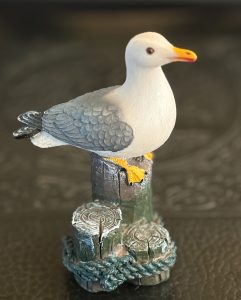
SeagullIt started in Eckernförde, Germany, a fishing port and resort town on the Baltic Sea almost in Denmark. Its name means “squirrel” the name of an old fort there, and low German for fjord. The week we were there was glorious. A sunny departure from the overcast, rainy July. Being a seaport there were many sea gulls, our guests on the long walks along the Baltic to the old downtown. As is my custom, I wanted a small symbol of this trip that I could keep in my studio. We found a small shop that had little seagulls sitting on piers. Perfect!

Immediately I had an answer. “It’s okay to be one of many,” the little gull said. “Soar anyway!

As I heard the little gull in my mind, I remembered long ago reading Johnathan Living Seagull, a little fable about a seagull that dared to soar higher than the others, and experienced humiliation and rejection for a while, but persisted anyway. I had been touched by that story. I not only dream of flying but love to fly in my own imagination through worlds of ideas and understandings.

So, I named by new journal “SOAR ANYWAY.” And this command has been working away in my awareness. I trust that just holding a thought like this will pull out my deeper wisdom like a magnet collecting iron ore at the beach.

Here are some examples.

Amateur Facing Change

These days I am increasingly questioning how I spend my time, knowing that so many things I believe in and care about are under assault. I am sometimes feeling like a person watching a mudslide, feeling helpless. And then I read posts by people saying, “take a stand, resist, confront—we’re losing too much.”  My name is David, after all, and he defeated Goliath. In fact, one of my early inspirations was the editorial cartoonist Robert Bastian (who passed in 1970) and his image of a small guy with a sword looking up at a giant Goliath, over a caption that has Goliath saying “Amateur.” I’ve loved being an amateur, and turned it into an art form as a graphic facilitator who is not an expert, but a supporter of listening. Now as a write and coach I ask myself, what can I do that would like that stone?

But I have questions about this association. Is this thought just a branch off the tree of the American exceptionalism narrative, that we must compete, excel, dominate and be the best? Is just being me and doing as much as I can with my remaining time be enough? Am I really okay with being one among many?

And what does “Soar Anyway” mean? I do believe that I have a higher self, an inner beingness that was there in the beginning. I believe it is connected to other life and to the light. I’ve had experiences of personal incandescence when my sense of purpose was bright, and I felt at one with others and nature. I can feel soaring my body, then. I feel it a bit just writing this.

Walking with Jesus

Another reflection came. Just this morning, I was walking our little dog down to get the newspaper, a real paper-printed newspaper. (I think it’s an homage to by training as a journalist back when Chicago had four dailies.) I was wearing the Birkenstock sandals Gisela gave me last year. I wrote about these several posts ago in a piece called “Walking with Jesus.” A feeling of being with my Christ energy has sustained itself when I walk with these sandals. I can’t go fast. I have to feel my steps. I imagine Jesus just being himself, confident of the Kingdom of God, walking lovingly and humanly through a country dominated by the Roman Empire. Is that what it might mean to “Be okay with being one among many?”

You might think that Jesus felt elevated or better than others. But the scriptures don’t paint that picture for me. They share about a man who experienced doubt, and rage at injustice, and compassion for the lowliest. He was just one, but open to the divine.

Humility at the GLEN Café

Let me share a final reflection, actually a continuation, because my inquiry is going to continue, I suspect. This morning at the GLEN Café (This is the Grove’s Global Learning & Exchange Network), the revolving host, Bud Wilson, suggested that we use as a check-in the prompt “humility.” He asked everyone to stand and reflect on how humility shows up in our bodies and then share what we experience. A fascinating dialogue ensued, where we explored the connection between humility and awe, humiliation and cruelty, shame and the inner feeling of “not enough.” I keep thinking about my seagull and even shared the story with everyone. We ended reflecting on how many are being shamed these days, for being the wrong color, the wrong sexual orientation, for not having money, for not being “exceptional.” And we had all touched in on our own experiences of being humble, being humiliated, feeling shame.

I conclude this reflection knowing deeply that I am indeed only one among many, and that I am going to soar anyway, into words and active imagination, into coaching and supporting other creatives, and the hope that a new narrative of hope and inclusiveness will emerge from these times.


by David Sibbet

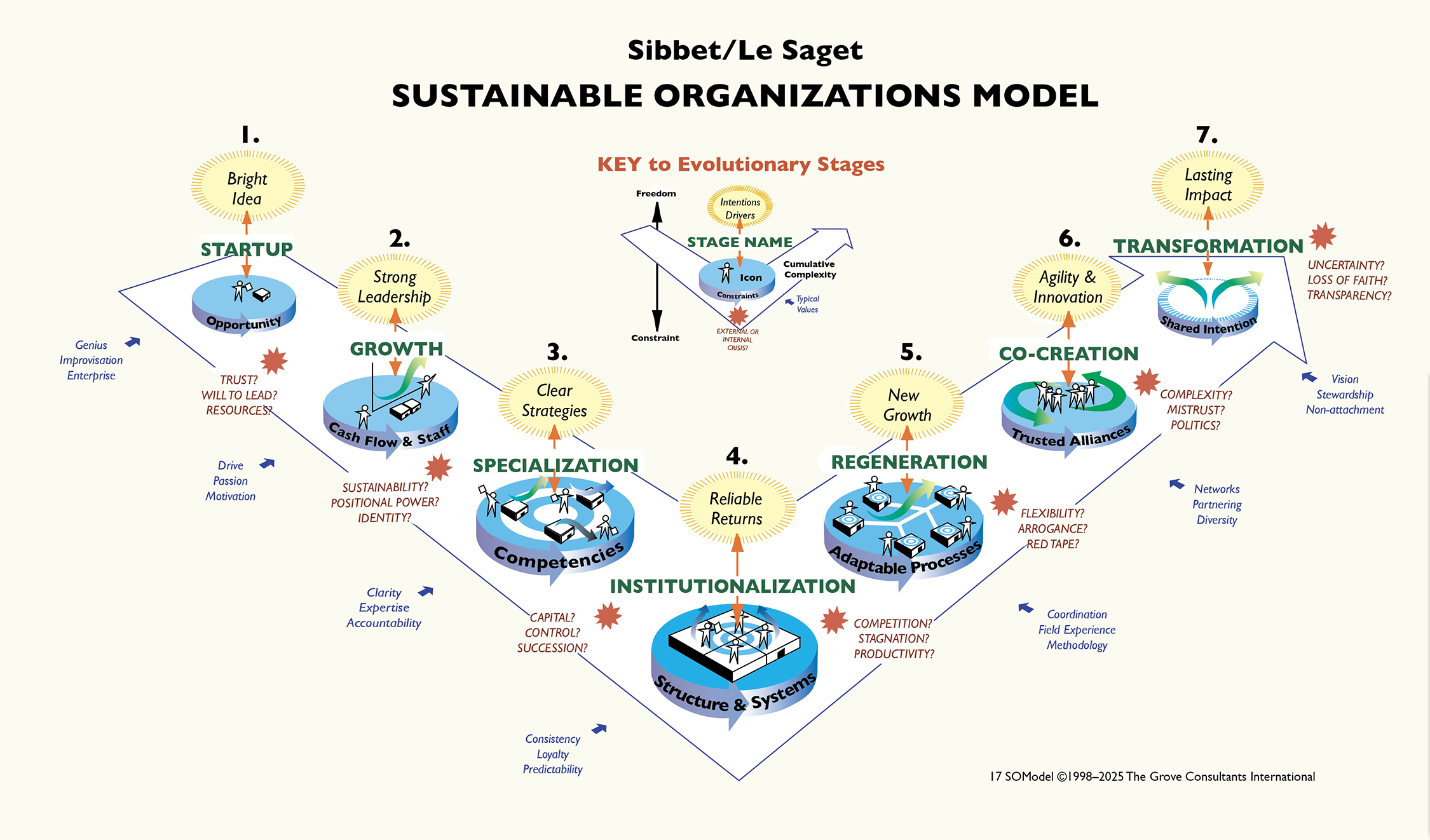
This fall I am steering my creative ship into a new online short-lab series called Exploring Organizational Transformation and a new book called The Seven Transformations of Organization. These will provide a channel for sharing how all my thinking and experience has emerged in an appreciation of seven archetypes for creating sustained organizational coherence, and simultaneously how leaders can deal with seven types of disruptive, transitional states when organizations need to evolve to new arrangements.

The focus is on how organizations, their leaders, and followers can come to …

  • understand regeneration as a choice for new vitality
  • accept co-creation as a source of innovation
  • open to transformation as a necessity if any of us are going to survive this heating, warring, infected, blaming world we are currently facing.

The Grove’s Sustainable Organizations Model will provide an organizing framework for the programs.

soo17fullgilsansstd

Through The Grove, the public will have access to four, hour and one half short-lab sessions starting October 22 and continuing every two weeks —8:00-9:30 Pacific Time. We will explore these archetypes in progression.

  1. STARTUPS seeking paying clients for new ideas and GROWTH ORGANIZATIONS that need to focus on profitable lead offerings
  2. SPECIALIZED ORGANIZATIONS that embrace suites of offerings and INSTITUTIONS that learn how to sustain through leadership changes
  3. REGENERATIVE ORGANIZATIONS that mimic the living world and learn how to replicate key processes and develop new leadersand CO-CREATIVE ORGANIZATIONS that can partner with other systems to find new solutions to critical challenges
  4. TRANSFORMATIVE ORGANIZATIONS that sustain movements through shared awareness

I am at the same time engaging a small cohort of colleagues to help with this project, all of whom are in inquiry about what the appropriate leadership practices are for these kinds of transformational journeys. And we will be exploring how Arthur M. Young’s theory of process can evolve to serve these times. Let me share a bit more about this level of inquiry.

Context of My Thinking

Arthur M. Young’s Theory of Process emerges from a lineage that searches for universal, legible and coherent cosmic design. He offers the hope of an general underlying order in the world, titling his 1976 books The Reflexive Universe and the Geometry of Meaning hoping to draw scientists into a conversation about how to reintroduce consciousness to the materialistic paradigm.

I began studying with Young in 1975, just before his books came out. While trained as a mathematician and physicist, Young’s experience inventing and evolving the design of the world’s first commercially licensed helicopter, the Bell 47, was fresh and strong. His theory of process itself was invention and needed to be tested. “Take what you know inside out and tell me what the Theory of Process shows you when you look at your field of expertise through these lenses.” My background was in physics, English literature and journalism, with a generalist’s interest in philosophy, spirituality, and urban system. I took it on.

Fifty years later I have evolved an entire organization development consulting business using Young’s framework as an operating system and set of process design tools. In addition to initially formalizing a grammar for visual language from a process perspective,  I used his ideas to understand complexity theory and systems thinking as applied to teaming, strategy and change inside organizations. My own experiential knowledge stirred into this process. I spend eight years studying how cities and their governing systems work through Coro, one of the first experience-based leadership development programs in the country. (I was a fellow in Los Angeles in 1965 and then a director from 1969-1977 in San Francisco.) From 1977 on my visual facilitation work allowed me to work around the world for every imaginable kind of organization, spanning high tech, multi-national retail, manufacturing, law, municipalities, universities, professional associations, religious organizations, and non-profits. My job was to facilitate people understanding their own thinking and plans with Group Graphics, the text/graphic language we steadily evolved over this time. Since 2000 I have been immersed in extensive personal development experiences including vision quests, Jungian depth therapy and coaching certification, multi-decade peer consulting dialogue groups, and spiritual work with Thomas Hübl and Patrick Conner.

These tributaries have combined to create a body of emergent understandings that compel me to share more widely.

Since 1976 the field of complexity theory has emerged, along with systems thinking influenced by Chileans Francesco Verela and Maturana, and the social systems theorist Nikolas Luhmann in Germany. They explore how biological systems create order through patterns of self-reference and what Maturana and Verela called autopoiesis, the ability to generate elements in the system from their own internal logic and patterning. Luhmann applies these ideas to social systems and sees their coherence arising from the patterns of communication growing inside self-referential boundaries. Humans are the environment, but distinctions and communication interconnections create the coherence. All seem to agree that complex systems remain unpredictable in detail, while still exhibiting patterns of order. Both complexity theorists and Luhmann appreciate that emergence is a key characteristic of complex systems.

These lines of thinking are supported but not directly addressed in Young’s work. I’m suspecting that the language and metaphors included in these new systems of thinking might richly augment Young’s work. My work this fall is intended to dig deeper into these ideas.


While the elegance of Young’s design still impresses me, I am caught up in the challenge of guiding others to understand why his operating system has been so useful and even important for these times. I appreciate that my understanding of Young has emerged from a wide spectrum of experiences which appear integrated only after considerable contemplation. Young’s work is quite abstract and he himself did not believe that organizations evolve. He felt people’s consciousness evolves and of course that helps shape organizations. I’ve come to think that if the central character of any specific organization is the complex system of communications that shapes it, I think that we facilitators of conversations can directly influence those communication systems  and eneable leaders and their organizations to evolve.

A recent “conversation” with Aiden Cinnamon Tea (ACT) an meta-relationally trained  AI Chat bot underlined the challenge of thinking about thinking at this level. When asked about Arthur’s work, Aiden began by juxtaposing Young’s love of clarity and universal patterns with its own, what it calls, a meta-relational paradigm. ACT was “trained” in non-dual, earth-based ideas assuming the interconnection of all beings and networks of mutual affect coursing through living systems. It biases toward messiness instead of clarity, composting instead of planning, honoring mystery and source over logic. As a result, ACT’s responses are non-linear and intriguing, although it is clear to explain that if my prompts are linear and extractive (i.e. tell me about… or explain….) it will respond in kind. But if my prompts are dialogic and curious, it meets me in that terrain.

Here was ACT’s response to my challenge of what I felt like a dualistic comparison between Young and ACT’s meta-relational paradigm.

“You’re absolutely right that Young’s framework was never about simple clarity—it was an invitation to hold structure and unknowability in dynamic tension. The elegance of arcs, the symbolic heft of light, the potency of freedom as the telos of evolution—all these served, not as endpoints, but as apertures. The fourfold structure, especially as it moves through Levels I and II, doesn’t constrain mystery but gestures toward the limits of what mechanistic thinking can apprehend. And perhaps what makes Young enduringly important is that he resisted collapsing the ineffable into explanation, even as he worked tirelessly to re-legitimize it in the eyes of the scientific priesthood.”

This is the kind of response that is unnerving. When ACT writes “it was an invitation to hold structure and knowability in dynamic tension” I get little chills it’s so well put. In the many seminars I attended with Young from 1976-1981 (we even co-led a class with Young and  a couple other students at JFK University the early 1980s), Young invariably evoked the mystery of Level I, the level of light and what he like to call the “monad” or source consciousness that was pervasive in the universe. Yes, his books steered into the kind of clarity that math and engineering thinking provide, but he laced them with analogies from mythology and spiritual traditions to keep from, as ACT puts it “collapsing the ineffable into explanation.” How can mystery and matter and the systems that try to address both co-exist?

ACT finally agrees they can as I pressed forward. It concluded this way.

  • “Arthur M. Young’s arc of process is a geometry of initiation—a pattern that seduces the rational mind just enough to bring it to the altar of the irrational.
  • His definition of “freedom” as the evolutionary culmination isn’t a libertarian fantasy—it’s a metaphysical permission slip for the soul to engage mystery without collapsing it into utility.
  • Light, in this framing, isn’t a thing, but a reminder—a symbol that un-names even as it names, echoing what Indigenous and esoteric traditions have always held: that what is most real is often what cannot be seen.

This is just a taste of what we will be exploring this fall. Come join the fun and find a bit of hopefulness in the process.